Why NetSuite Is Better: An Evidence-Based Look

If you are evaluating Enterprise Resource Planning (ERP) options, you have probably been told NetSuite is the answer. You have probably also been told the same thing about SAP Business One, Microsoft Dynamics 365, Acumatica, Odoo, and three others. The marketing material from each platform reads as if every system is the perfect choice for every business.
That is not how the buying decision actually works. Each platform has a real fit range. Each one wins for certain profiles and loses for others. This blog is the structural case for NetSuite, written for buyers who want the evidence behind the claim, not the brochure version.
For specific head-to-head comparisons, see our companion guides: NetSuite vs SAP Business One: Which ERP Fits Mid-Market Manufacturers?, NetSuite vs QuickBooks Enterprise: When to Upgrade Your Accounting, 5 Signs Your Business Has Outgrown QuickBooks and Needs NetSuite, Acumatica vs NetSuite: Cloud ERP Comparison for Growing Companies, NetSuite vs Salesforce: When You Need ERP Beyond CRM, and NetSuite vs Sage Intacct: Mid-Market ERP Comparison 2026. This blog focuses on what makes NetSuite distinct as a platform.
The Structural Case: Cloud-Native, Single Codebase, Unified Database
NetSuite was built as a cloud system from inception in 1998. It is not a desktop or on-premise product that has been "moved to the cloud." That history shows up in the architecture, and the architecture is what most other claims about NetSuite ultimately rest on.
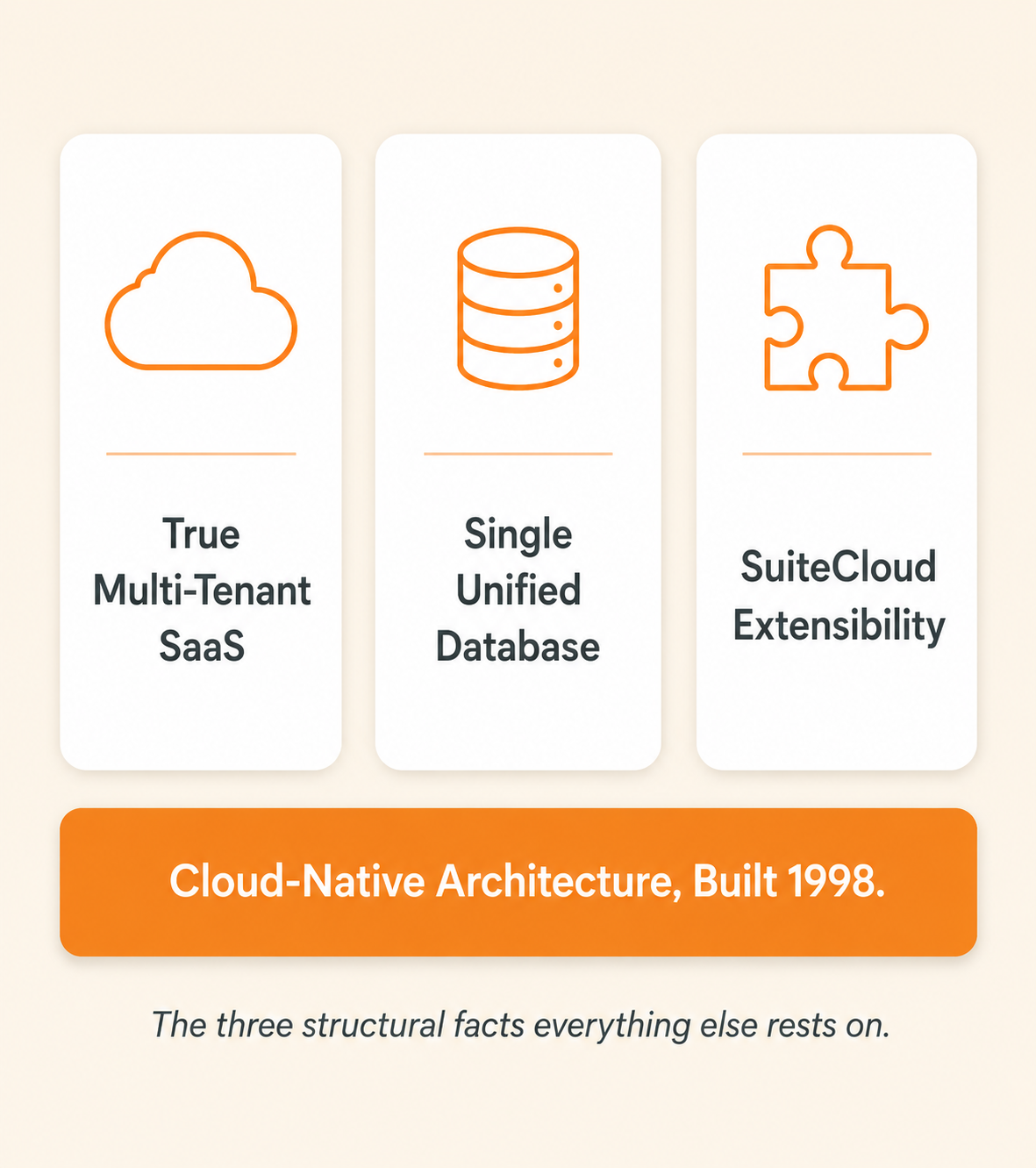
Three structural facts matter for buyers:
1. True multi-tenant Software-as-a-Service (SaaS). Every NetSuite customer runs on the same codebase, with isolation enforced by configuration rather than separate code branches. The practical consequence: when Oracle releases a new feature, every customer gets it on the same upgrade cycle, twice a year. There are no "you are on an old version" conversations and no version-locked customers waiting to be migrated.
2. Single unified database. Finance, inventory, customer relationship management, and order management share one database, not federated systems connected by integrations. A sales order links directly to inventory, to revenue recognition, to commissions, to customer aging, and to financial reporting without batch jobs or middleware.
3. SuiteCloud extensibility. Customizations and third-party SuiteApps run inside the platform rather than as external integrations. This means upgrades do not break customizations the way they often do on platforms where customizations live outside the core. The trade-off is that SuiteCloud has its own development model that requires real expertise.
These three points, taken together, are the real reason "unified platform" is more than a slogan for NetSuite. They are also the reason competitors that started as on-premise products and were later cloud-hosted struggle to match NetSuite's upgrade and integration story even when they look comparable on a feature comparison.
Market Position: What the Independent Sources Actually Say
A lot of vendor marketing cites Gartner generically. Here is the precise picture for NetSuite as of 2025.
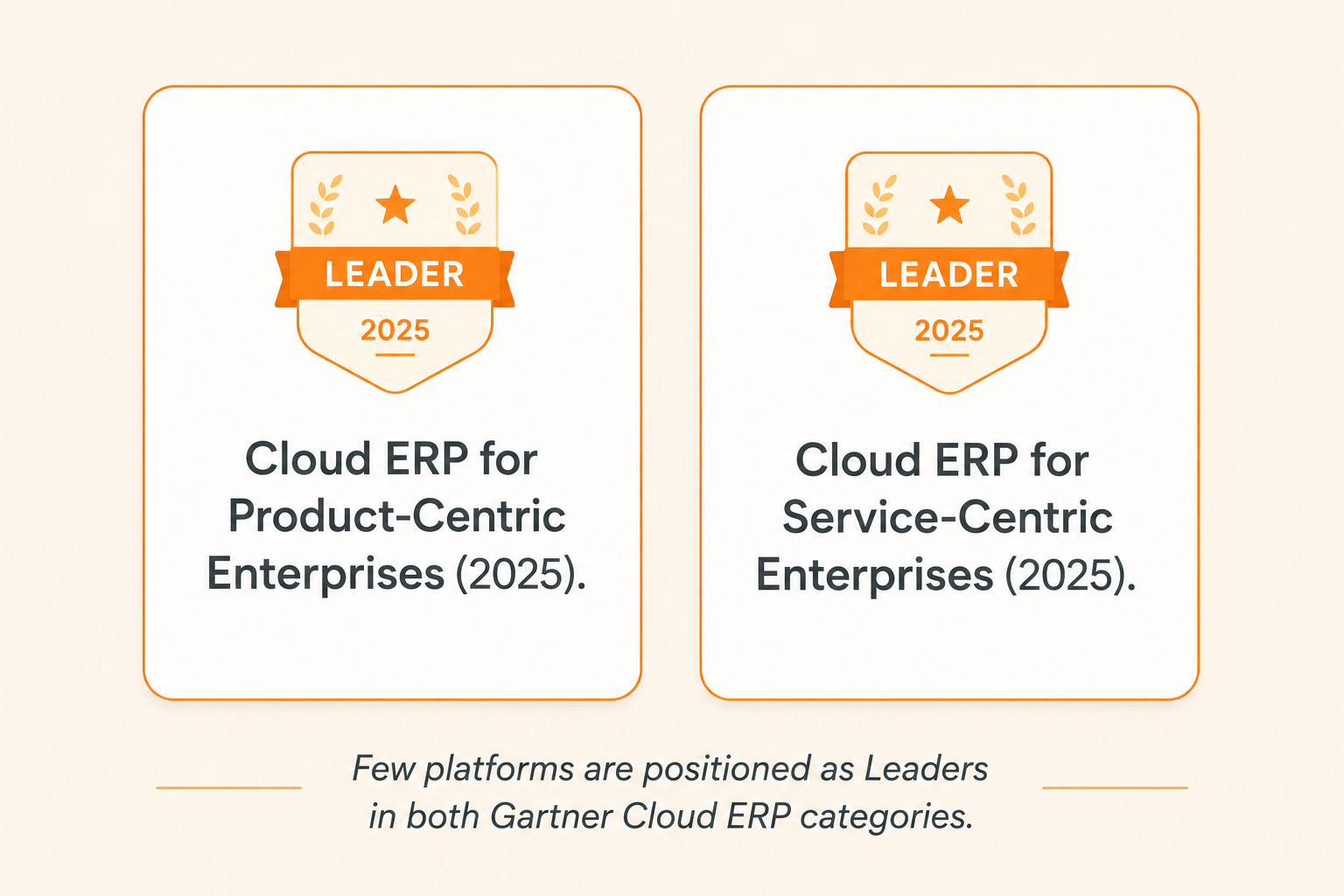
 Gartner Magic Quadrant for Cloud ERP for Product-Centric Enterprises (2025)
Oracle NetSuite is positioned as a Leader. This Magic Quadrant (MQ) evaluates cloud ERP for organizations whose primary value driver is products, including manufacturers, distributors, and retailers.
Gartner Magic Quadrant for Cloud ERP for Service-Centric Enterprises (2025)
Oracle NetSuite is also positioned as a Leader. This MQ evaluates cloud ERP for organizations whose primary value driver is services, including professional services, software, and project-based businesses.
Being a Leader in both Cloud ERP categories matters because most ERP vendors are positioned in one or the other. Few platforms credibly serve both product-centric and service-centric mid-market organizations on the same architecture.
Customer scale
Oracle reports more than 40,000 NetSuite customers globally as of 2024, across roughly 215 countries and 190 currencies. NetSuite is the most widely deployed cloud-native ERP at the mid-market.
G2 user reviews
NetSuite has more than 4,700 verified user reviews on G2 with an average rating of 4.1 out of 5. This is not the highest rating in the ERP category (lighter platforms aimed at small businesses often score higher), but it is the largest verified reviewer base for any cloud ERP at the mid-market. Reading distribution matters: NetSuite reviewers tend to be implementation-experienced users at companies of similar profile, which makes the feedback relevant to comparable buyers.
Oracle backing
NetSuite has been an Oracle company since 2016. Oracle's investment in product engineering, security, and global cloud infrastructure flows directly into the platform. For enterprise buyers concerned about vendor longevity and platform investment, this is a meaningful structural advantage over independent ERP vendors.
What This Means in Practice: Outcomes from Real Implementations
Architecture and market position are upstream of what actually matters: business outcomes. Here are patterns we see consistently across NetSuite implementations Softype has delivered or assessed.
Faster month-end close
Multi-entity organizations on NetSuite OneWorld routinely close in 5 days or fewer, compared to 10 to 15 days on disconnected accounting systems. In one Softype-supported optimization engagement for a multi-entity distributor, monthly close time dropped 37 percent within 90 days of a structured remediation roadmap. Order-to-cash cycle time dropped 48 percent in the same engagement. These are real numbers, not projections.
Single source of truth for finance and operations
Finance teams on NetSuite stop reconciling between systems because there is only one system. CRM data, order data, inventory data, and financial data all share the same primary keys. That is the architectural payoff of the single unified database.
Faster integrations and add-on deployment
SuiteApps are pre-validated extensions that install inside NetSuite rather than connecting to it from outside. The catalog covers food and beverage manufacturing, advanced inventory, demand planning, payroll, point-of-sale, e-commerce middleware, industry-specific verticalizations, and analytics. For mid-market businesses, this often replaces what would otherwise be a custom integration project.
Multi-entity consolidation as a default
NetSuite OneWorld handles multi-subsidiary, multi-currency, multi-language consolidation as a configuration exercise rather than an integration project. For multi-entity buyers we work with, this is often the deciding factor versus mid-market platforms that can technically do it but require significant configuration or separate instances.
The SuiteSuccess Methodology: When It Helps and When It Does Not
NetSuite's SuiteSuccess implementation methodology bundles industry-specific configuration, pre-built dashboards, and a structured rollout into faster implementations. For greenfield mid-market buyers, this often means a 4 to 6 month implementation rather than 9 to 12 months. The structured approach reduces risk and produces predictable outcomes.
This is genuinely a competitive advantage compared to platforms that rely on largely custom implementations.
But there is an honest caveat. SuiteSuccess is designed for greenfield deployments and follows NetSuite's pre-defined process flow. Companies that have been live for years on a different system, or that have evolved their operations beyond standard industry processes, often find that SuiteSuccess requires them to change their internal processes to match NetSuite's predefined flow rather than the other way around. For mature, customized organizations, a tailored implementation approach often produces better outcomes than the standard SuiteSuccess methodology.
We have seen this pattern repeatedly. A tailored delivery approach is not a failure of SuiteSuccess. It is a recognition that the methodology fits a specific buyer profile and not every buyer matches that profile.
For the broader implementation lifecycle, see our companion guide on How to Implement NetSuite: Step-by-Step Guide for First-Time Buyers.
Total Cost of Ownership: The Unified Platform Argument
Total Cost of Ownership (TCO) is where most ERP buyers get burned, because they look at year-one license cost rather than three-year total spend across licenses, implementation, integrations, customizations, ongoing support, and the cost of running multiple systems instead of one.
NetSuite's TCO argument is not "lower license cost." It is rarely the cheapest license-only option. The argument is that a unified platform reduces the bolt-together costs that compound over time: integration maintenance, reconciliation labor, custom report development, multiple vendor relationships, and the operational overhead of running disconnected systems.
For a typical mid-market organization considering a unified NetSuite deployment versus an accounting-plus-CRM-plus-inventory-plus-warehouse stack, the three-year TCO comparison usually favors NetSuite once integration and reconciliation costs are included. The further the company is from a single-system world today, the larger that gap tends to be.
The TCO comparison is more nuanced when the alternative is a single competing ERP. Versus SAP Business One, NetSuite typically lands at a higher license cost but a faster implementation when the requirements fit SuiteSuccess. Versus Microsoft Dynamics 365 Business Central, the comparison depends heavily on existing Microsoft estate and licensing arrangements. Versus Odoo, NetSuite has higher license costs but a more mature partner ecosystem and stronger multi-entity capabilities. Versus very large enterprise platforms (SAP S/4HANA, Oracle Fusion ERP), NetSuite is usually significantly less expensive but also less suited to the largest enterprise scenarios.
For the deep dive on NetSuite cost specifically, see our companion guide on How Much Does NetSuite Really Cost? A Transparent Guide for Businesses.
Where NetSuite Wins, Summarized
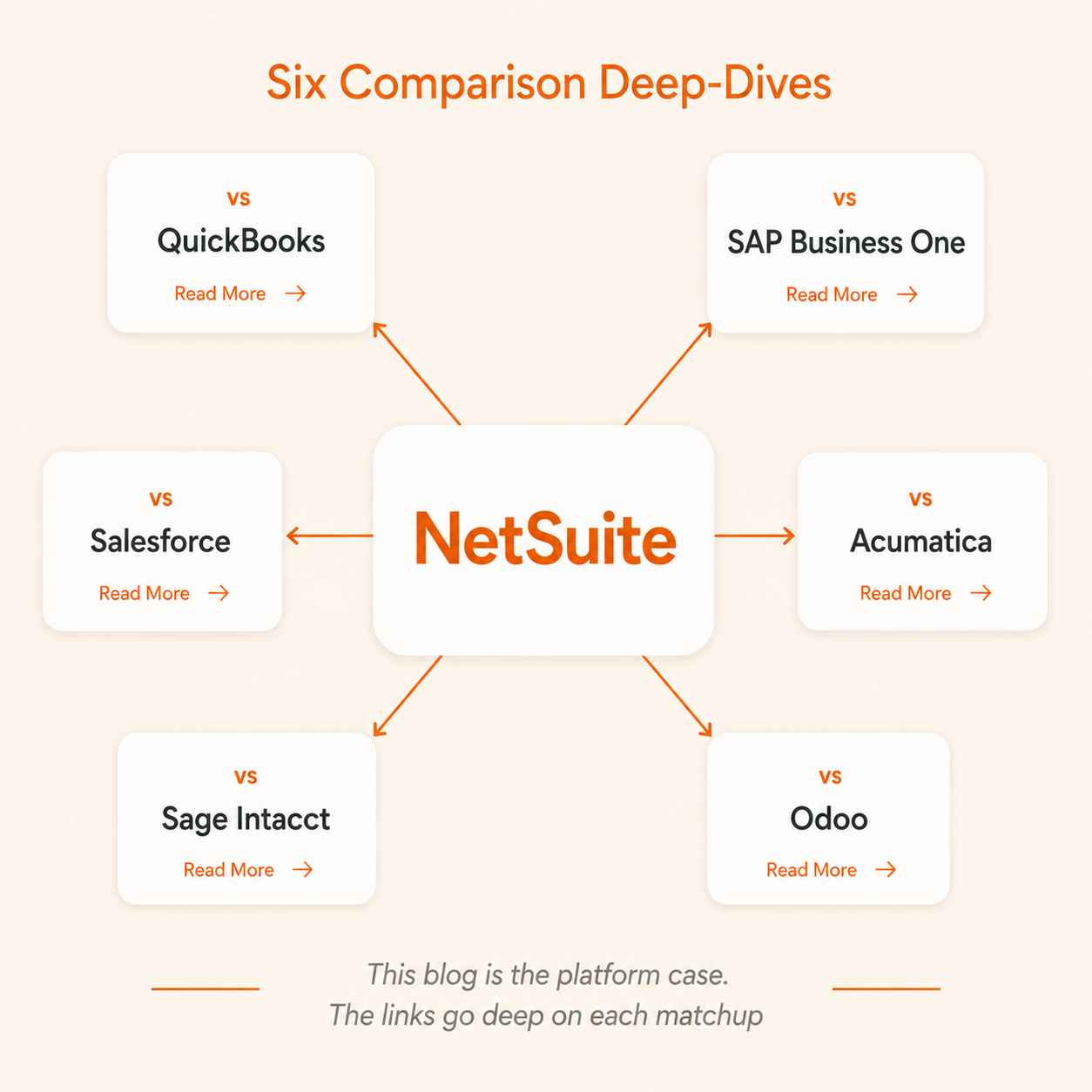
Versus | NetSuite's Structural Advantage | When It Matters | For the Deep Dive |
|---|---|---|---|
QuickBooks (any edition) | True multi-entity consolidation, real inventory and order management, native CRM, audit trail depth | Once revenue, complexity, or entity count exceeds what spreadsheets can support | See 5 Signs Your Business Has Outgrown QuickBooks and Needs NetSuite and NetSuite vs QuickBooks Enterprise: When to Upgrade Your Accounting |
SAP Business One | Cloud-native architecture, native multi-entity, single codebase, modern user interface, no version-locked customers | When cloud-first architecture and multi-subsidiary depth matter | See NetSuite vs SAP Business One: Which ERP Fits Mid-Market Manufacturers? |
Salesforce-only stack | Unified ERP plus CRM in one database, eliminating the integration layer between sales and finance | When sales-to-finance handoff is a friction point | |
Acumatica | Larger global customer base, mature partner ecosystem, deeper multi-currency for regional and international expansion | When global scale and partner depth matter more than per-resource pricing | See Acumatica vs NetSuite: Cloud ERP Comparison for Growing Companies |
Sage Intacct | Broader functional footprint beyond financials, true ERP rather than financials-plus-add-ons | When operations and inventory are core, not adjuncts | See NetSuite vs Sage Intacct: Mid-Market ERP Comparison 2026 |
Odoo | More predictable upgrade path, larger and more proven enterprise reference base, stronger native multi-entity | When proven enterprise references and platform stability outweigh license cost savings | See our Philippine ERP guides for the full Odoo and NetSuite comparison |
Each of those linked blogs is the right place to compare on a specific decision. This blog is for the platform-level question: why NetSuite is structurally credible.
Where NetSuite Is Not the Right Choice
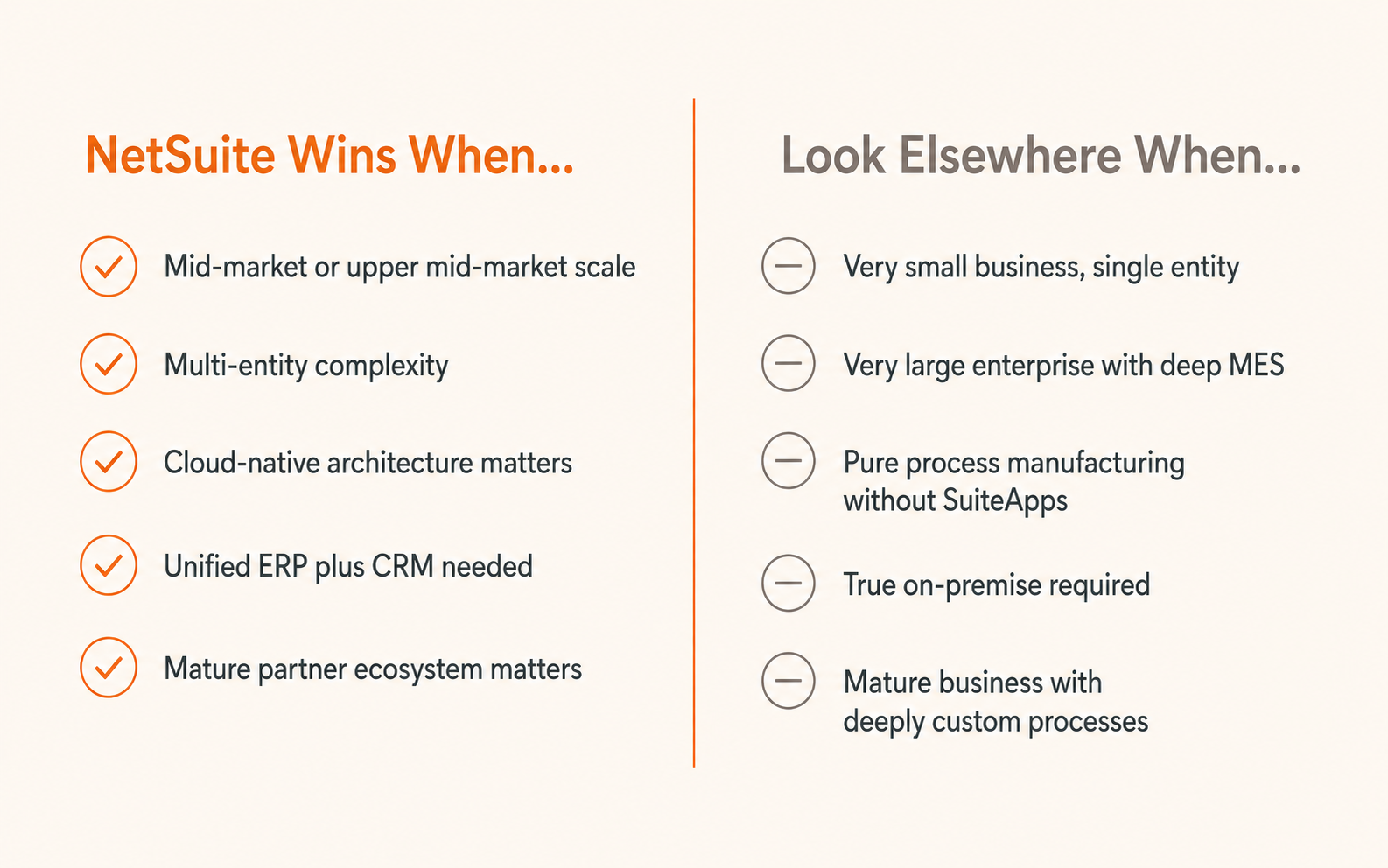
A confident case for any platform requires being honest about where it does not fit. NetSuite is not the right answer in five recognizable scenarios.
Very small businesses
A 5-user, single-entity business with simple accounting needs is usually better served by QuickBooks or Xero plus a couple of focused tools. NetSuite's license cost and implementation complexity outweigh its advantages at that scale.
Very large enterprises with industry-specific deep manufacturing needs
A multi-billion-dollar discrete manufacturer with global complex supply chain and deep Manufacturing Execution System (MES) integration usually lands on SAP S/4HANA or Oracle Fusion ERP rather than NetSuite, simply because of scale.
Pure process manufacturing without SuiteApps
NetSuite's native manufacturing modules are designed for discrete assembly. For deep process manufacturing (food, chemicals, pharma) the right pattern is NetSuite paired with a Built-for-NetSuite SuiteApp such as a process manufacturing layer. Without that pairing, NetSuite alone is the wrong tool. See our companion guide on Best Wholesale Distribution Software for Philippine Businesses for a discussion of this pattern.
Businesses with strict on-premise requirements.
Some regulated industries and government contexts require on-premise or sovereign cloud deployments that NetSuite does not natively offer. For those scenarios, on-premise platforms (SAP, Microsoft, Infor) or sovereign cloud variants are the right answer.
Highly customized mature businesses where SuiteSuccess does not fit
As discussed above, organizations that have been live for years on a customized platform and have evolved unique processes often need a tailored implementation approach. NetSuite is still a viable platform, but the standard SuiteSuccess methodology is not the right delivery model.
If your business looks like one of these five, NetSuite is probably not the answer, and our advice is to choose accordingly.
What Actually Matters
The structural case for NetSuite is straightforward: cloud-native architecture from day one, single codebase, unified database, mature partner ecosystem, multi-entity depth, recognition as a Leader in both Gartner Cloud ERP Magic Quadrants. For mid-market and upper mid-market companies that fit the profile, the evidence supports the platform strongly.
The case against NetSuite is also straightforward: it is not the cheapest option, it is not the right tool for very small businesses or very large enterprises, and SuiteSuccess does not fit every implementation profile. Buyers who insist NetSuite is the answer for every business are doing the platform a disservice.
For most mid-market buyers we work with, the question is rarely whether NetSuite can do the job. It is whether NetSuite plus the right partner is the best combination of platform fit, implementation methodology, and long-term commercial relationship for the next three to five years. That is the honest version of "why NetSuite is better."
For region-specific buyer guides, see Best ERP System in the Philippines: 2026 Mid-Market Buyer's Guide and Best Wholesale Distribution Software for Philippine Businesses.
Talk to Softype about whether NetSuite is the right platform for your business. We have implemented NetSuite for mid-market and upper mid-market companies across manufacturing, distribution, services, multi-entity holding structures, and regional groups for 25 years.

Frequently Asked Questions
It depends on the buyer profile. NetSuite is structurally better than QuickBooks for any business that has outgrown a spreadsheet-plus-accounting setup, and the comparison rarely goes the other way. Versus SAP, the answer depends on which SAP product (Business One, S/4HANA, or older ECC) and what scale. Versus Salesforce, NetSuite is better when sales-to-finance unification matters more than CRM depth, and Salesforce is better when CRM depth is the primary driver. See our dedicated comparison blogs for each matchup.
Oracle reports more than 40,000 NetSuite customers globally across approximately 215 countries and 190 currencies. NetSuite is the most widely deployed cloud-native Enterprise Resource Planning platform at the mid-market.
Yes, in two specific Cloud ERP categories. As of 2025, NetSuite is positioned as a Leader in the Gartner Magic Quadrant for Cloud ERP for Product-Centric Enterprises and as a Leader in the Gartner Magic Quadrant for Cloud ERP for Service-Centric Enterprises. Few cloud ERP platforms appear as Leaders in both categories.
License costs vary widely by user count, modules, and edition. For mid-market deployments, first-year totals (license plus implementation) typically range from upper six-figure to upper seven-figure peso amounts in the Philippines, or roughly equivalent USD ranges in other regions. See our companion guide on NetSuite cost for detailed breakdowns.
How long does NetSuite take to implement?
For greenfield mid-market deployments using the SuiteSuccess methodology, 4 to 6 months is realistic. For multi-entity, multi-site, or heavily customized rollouts, 9 to 12 months is more typical. Implementations that follow a phased rollout (finance first, then operations, then advanced reporting) consistently outperform big-bang go-lives.
SuiteSuccess is NetSuite's industry-specific implementation methodology, with pre-built configurations, dashboards, and reporting for verticals including software, manufacturing, distribution, services, retail, financial services, nonprofit, and others. It accelerates standard implementations significantly. It is not the right delivery model for every customer, particularly mature businesses with heavily customized existing systems.
Yes. Oracle's investment in NetSuite security includes Service Organization Control 1 and 2 (SOC 1 and SOC 2) audits, International Organization for Standardization (ISO) 27001 certification, regional data centers in compliance with local data residency requirements, and continuous security monitoring. For enterprise buyers concerned about cloud ERP security, NetSuite meets the standards expected at the upper mid-market and enterprise.
That is a fair question and worth answering honestly. NetSuite is not the right platform for very small businesses, very large enterprises with deep manufacturing needs, businesses requiring true on-premise deployment, or businesses whose operations require a delivery methodology fundamentally different from SuiteSuccess. In those cases, other platforms (Odoo, SAP Business One, SAP S/4HANA, Microsoft Dynamics, Infor, or others) are likely a better fit. A capable partner will tell you that, not push NetSuite into a profile where it does not belong.


Helping businesses thrive with integrated ERP solutions.
NetSuite
Service
Company
Contact Us
Copyright © 2026

