Accounts Payable Management: Best Practices for Mid-Market Companies

TL;DR
Accounts payable starts in purchasing, not finance. The supplier you choose, the payment terms you agree, and the tolerances you set for price or delivery differences all shape how smoothly AP runs later. For mid-market companies, getting AP right improves cash flow, cuts operational cost, and reduces risk. This guide walks through the full Procure-to-Pay process, seven practical best practices, a maturity model, and the metrics that actually matter.
Accounts payable starts in the purchasing department, not in finance. The supplier you choose, the payment terms you agree on, and the tolerance you set for price or delivery changes can all affect how smoothly AP works later. By the time an invoice reaches the finance team, many of these decisions have already been made.
For mid-market companies, AP can have a major impact on the business. Optimizing it improves cash flow without growing revenue. Automating it reduces operational cost. Getting it wrong creates duplicate payments, missed discounts, strained supplier relationships, and audit findings that all compound over time.
This guide is for finance and operations leaders who want to move their AP function from manual transaction processing to strategic working capital management. For the broader implementation context, see our companion guides: How to Implement NetSuite: Step-by-Step Guide for First-Time Buyers and NetSuite OneWorld: Multi-Entity and Multi-Currency ERP Guide. A dedicated companion piece on NetSuite AP automation is in development and will cover the technical implementation details.
What Accounts Payable Management Actually Covers
Accounts payable management is the end-to-end process of handling a company’s obligations to its suppliers, from invoice receipt through to payment. It includes:
Invoice capture and validation
Matching invoices with purchase orders and goods receipts
Approval workflows and exception handling
Payment scheduling and execution
Vendor relationship and credit-term management
Performance monitoring through operational and financial metrics
The common struggle for mid-market companies is rarely any single step. It sits in the handoffs between procurement, receiving, and finance. A clean AP process is really a clean Procure-to-Pay (P2P) process. The two cannot be separated.
The End-to-End Procure-to-Pay Flow
A complete Procure-to-Pay process moves through nine steps. Each step has owners, controls, and outputs.
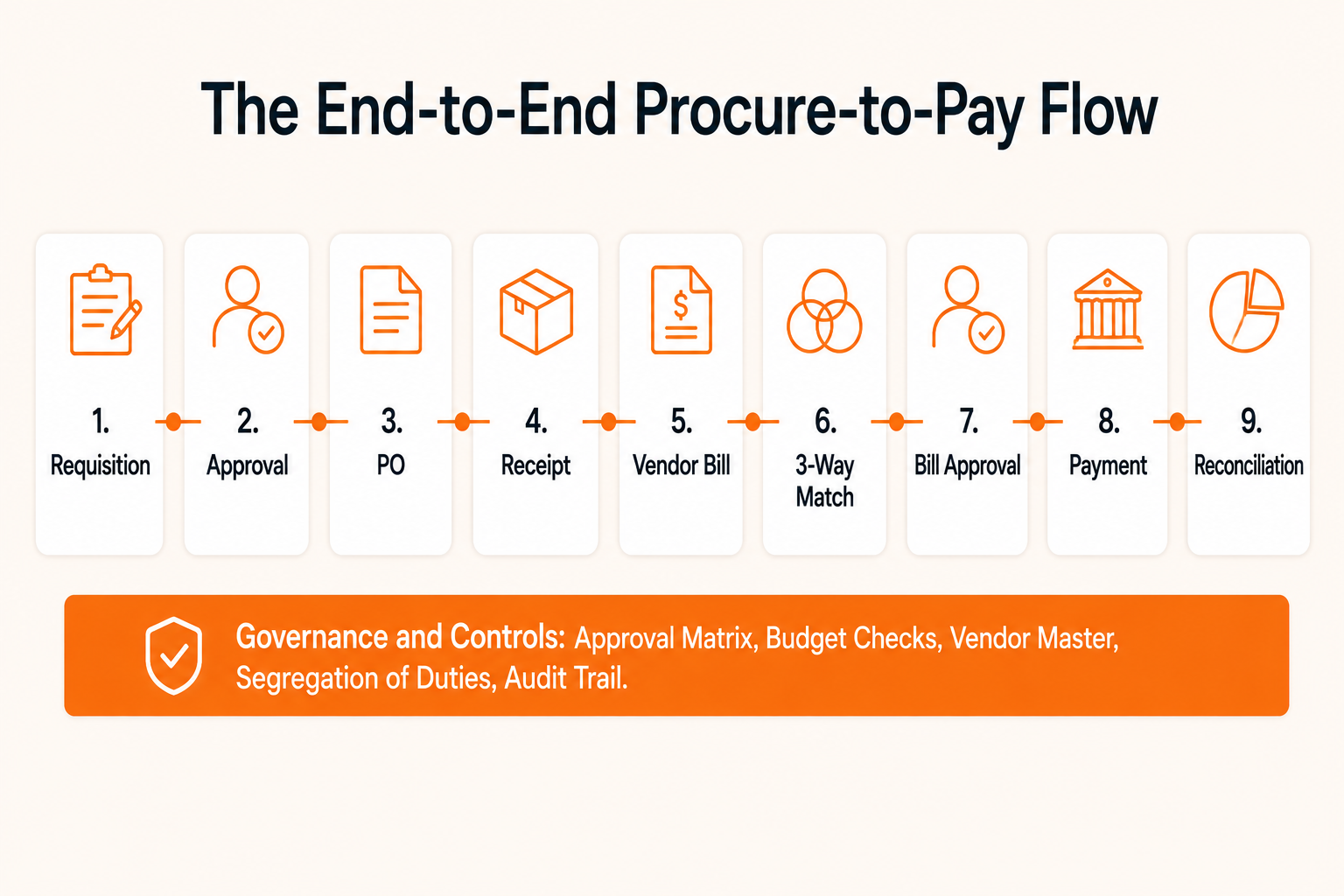
Step | Activity | Typical Owner |
|---|---|---|
1 | Purchase requisition with items, quantity, and budget code | Requester |
2 | Requisition approval via approval matrix | Supervisor / Finance |
3 | Purchase Order (PO) issued to vendor | Procurement |
4 | Item Receipt recorded against the PO | Warehouse / Receiving |
5 | Vendor Bill entered into Accounts Payable | AP Clerk |
6 | Three-way match (PO, Receipt, Bill) with tolerance check | AP Clerk / System |
7 | Bill approval and exception resolution | AP Manager |
8 | Bill payment per agreed terms | AP / Treasury |
9 | Reconciliation, audit trail, and spend reporting | Finance |
The governance and control layer wraps around this flow: approval matrix, budget checks, vendor master maintenance, segregation of duties, audit trail, and compliance (Sarbanes-Oxley (SOX), tax controls, local statutory reporting).
Companies that get AP right usually design the full P2P flow before configuring any individual step. Those that struggle often configure invoice capture and approval workflows in isolation, then discover that weak receiving practices, poor vendor-master quality, or missing budget controls undermine everything downstream.
Seven Best Practices for AP Management
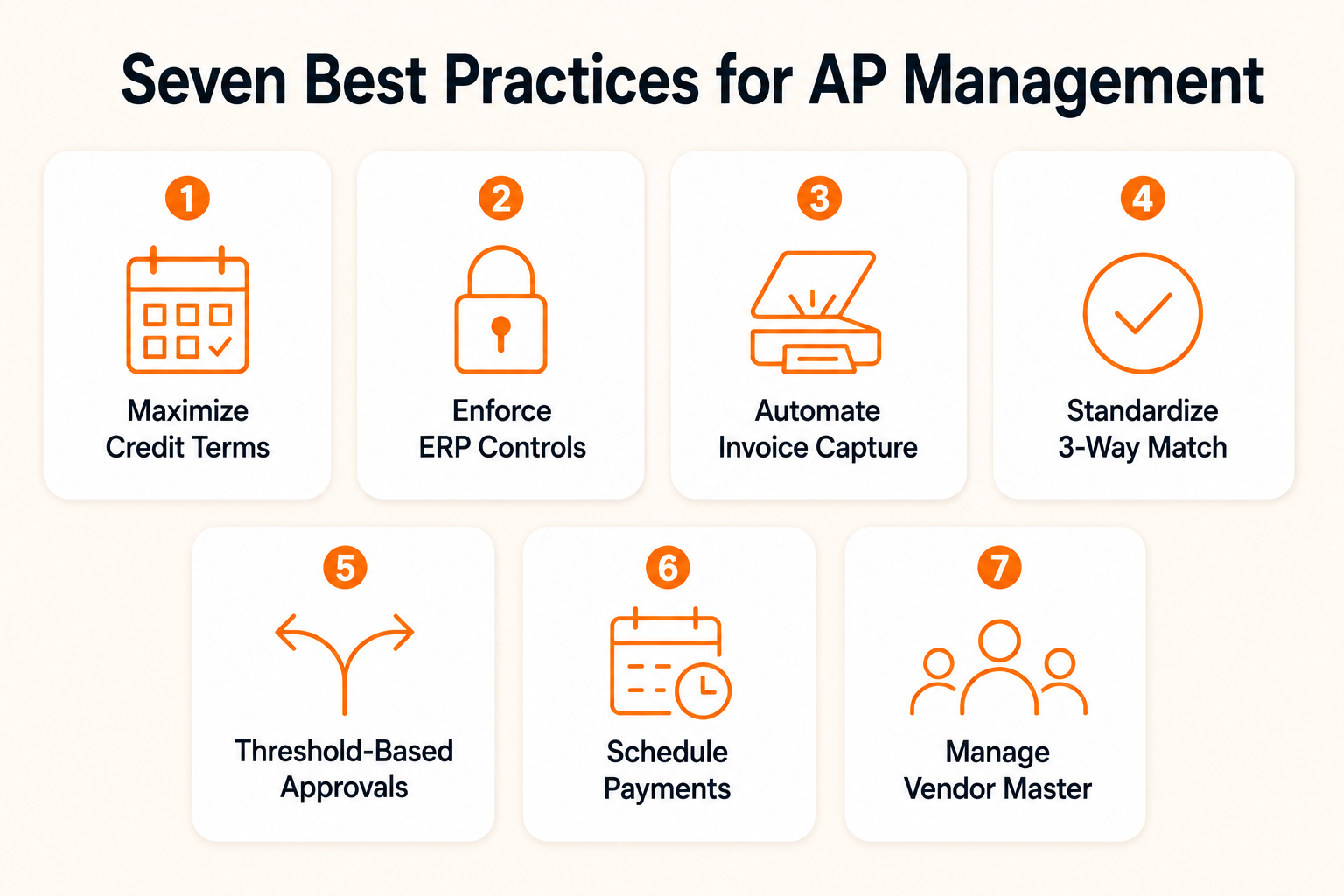
 1. Maximize Supplier Credit Terms, Within Reason
The single highest-impact lever in AP management is negotiating and using the maximum credit terms your suppliers will offer. Net 45 or Net 60 instead of Net 30 increases your Average Daily Balance (ADB), which improves interest income or reduces borrowing needs.
When negotiating terms, present strong financials and a clear payment history. Suppliers grant longer terms based on creditworthiness and the strength of the buying relationship.
The caveat: do not push aggressively with small or strategically important vendors. The financial gain from an extra fifteen days of float rarely outweighs the cost of a strained relationship with a vendor you depend on. Terms negotiation works best with larger suppliers where the relationship is genuinely commercial.
2. Enforce Credit Terms and Vendor Limits in Your ERP
Modern ERP systems have tools for managing credit terms and supplier limits. Make sure these controls are properly configured in your system.
Use the ERP to:
Track payment due dates automatically per vendor
Prevent early payments that erode your cash position
Block duplicate payments through invoice number matching
Monitor vendor-specific credit limits and total exposure
Apply payment terms (Net 30, Net 45, Due on Receipt) consistently
One common issue is companies that rely on AP clerks to remember each vendor's terms produce inconsistent payment timing. Companies that configure terms in the vendor master and let the system schedule payments produce predictable cash flow. The system-driven approach is the foundation for working capital optimization.
For a deeper look at how NetSuite handles these controls, including module pricing and license considerations, see NetSuite Pricing 2026: Complete Breakdown of Costs, Licenses and Hidden Fees.
3. Automate Invoice Capture
Manual invoice entry can quickly become a bottleneck as the business grows. For example, a finance team processing 500 invoices a month manually could spend 20 to 40 hours simply entering invoice data.
Modern AP automation tools use Optical Character Recognition (OCR) and machine learning to extract invoice data automatically, validate it against POs and vendor master data, and route exceptions for review. The technology has matured significantly. Best-in-class implementations process invoices in hours rather than days, with manual touch only on genuine exceptions.
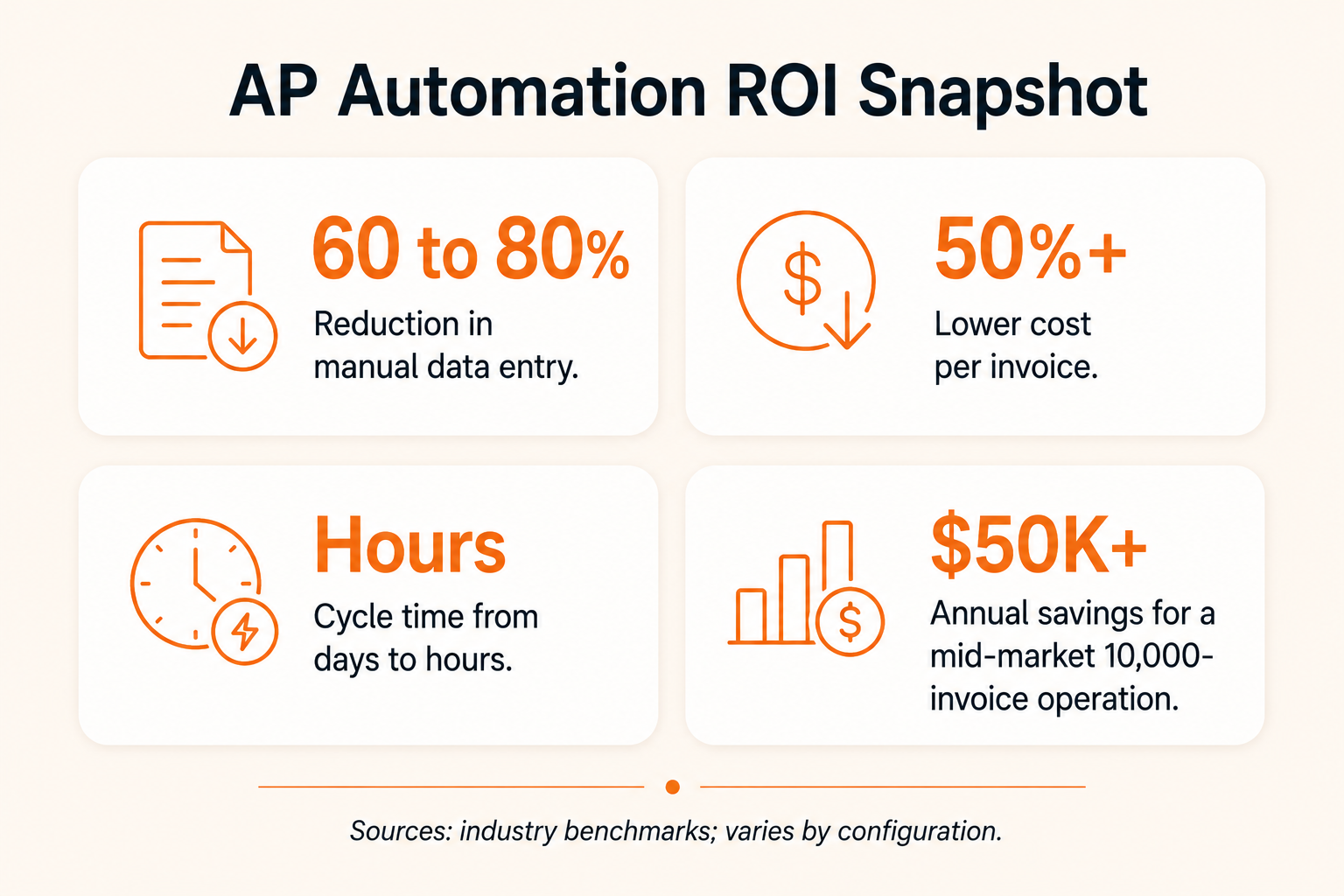
The ROI on AP automation is consistently strong: a 60 to 80 percent reduction in manual data entry, a 50 percent or greater reduction in cost per invoice, and improved audit trail quality. For a mid-market company processing 10,000 invoices a year at $10 each in fully-loaded cost, automation can reduce per-invoice cost to $3 to $5, freeing $50,000 or more in annual finance team capacity.
4. Standardize Three-Way Matching With Tolerances
Three-way matching checks three things before an invoice is paid: the Purchase Order, the goods receipt, and the vendor invoice. The system compares the quantities and prices and checks whether any differences fall within the allowed tolerance.
If everything matches, the invoice can move forward. If there is a larger difference, it is sent for review.
The mechanics:
The invoice item rate and quantity are compared to the PO and the Item Receipt.
Vendor tolerances are checked. If the variance is within tolerance, the bill is approved automatically.
If the variance exceeds tolerance, the bill goes to Pending Approval status and a case is created for the AP team to investigate.
After contacting the vendor, the bill is modified to the correct amount or the variance is allowed as an exception, and the bill is approved for payment.
A pattern we see across implementations is a 5 percent tolerance is the most common setting for three-way match in mid-market deployments. It catches material discrepancies while letting routine rounding and minor freight variances flow through automatically. Tolerances much tighter than that create exception fatigue. Tolerances much looser miss material errors.
One technical note for NetSuite environments: three-way matching is more complex when a single PO has multiple item receipts. Leading practice is to apply matching at the receipt level rather than the PO level in those scenarios.
5. Streamline Approval Workflows by Threshold
Approval delays are one of the most common causes of late payments and missed discounts. The fix is not to remove approvals. The fix is to route them intelligently.
Effective approval design:
Auto-approve low-value, low-risk transactions (for example, invoices under $5,000 from approved vendors with PO match within tolerance).
Route mid-value transactions to a single approver based on department or cost center.
Route high-value transactions through multi-level approval with explicit Service Level Agreements (SLAs) at each level.
Enable mobile or email approvals so approvers are not the bottleneck.
Build escalation rules for stalled approvals (after 48 hours, route to next level).
In practice , we’ve found every implementation we have done where approval workflows were designed by threshold rather than by blanket policy reduced approval-related cycle time by half or more. The cost of approval delay is real, and most of it is preventable.
6. Optimize Payment Scheduling, Not Payment Speed
Payment timing is a working capital decision, not an efficiency metric. The goal is not to pay faster. The goal is to pay on the right day.
Effective payment scheduling:
Pay on the due date, not earlier. Early payment without a discount is a free loan to the supplier.
Take early payment discounts when the math justifies it. A "2/10 Net 30" term offers a 2 percent discount for paying 20 days earlier, which annualized is roughly a 36 percent return on capital. That is almost always worth taking.
Batch payments to reduce transaction costs (ACH batches, payment runs).
Use the ERP's payment run functionality to apply consistent rules across vendors.
From our observation companies that pay invoices the moment they land in the system have functionally the same cost profile as companies that pay 60 days late. Both are bad. The first surrenders working capital unnecessarily. The second damages supplier relationships. The middle path is system-driven scheduling that respects terms and captures genuine discounts.
7. Manage the Vendor Master as Core Master Data
Vendor master quality is a quietly significant determinant of AP performance. Duplicate vendor records, missing tax IDs, inconsistent payment terms, and stale bank account details all create friction at the wrong moments.
Vendor master discipline:
One vendor, one record. Use match rules based on tax ID or unique identifier, not name matching.
Required fields enforced at creation: tax ID, payment terms, bank details where applicable, approved status.
Preferred vendor assignments per item where the buying pattern is stable.
Vendor performance tracking on delivery, quality, and Certificate of Analysis (COA) compliance for regulated industries.
Periodic vendor master cleanup (annually at minimum).
One of the best early warning tools you can set up is a saved search that compares vendor bill costs against the original purchase order. By automatically flagging rate changes that fall outside a normal range, you can catch honest mistakes and potential fraud before any money actually leaves your account.
The AP Maturity Model
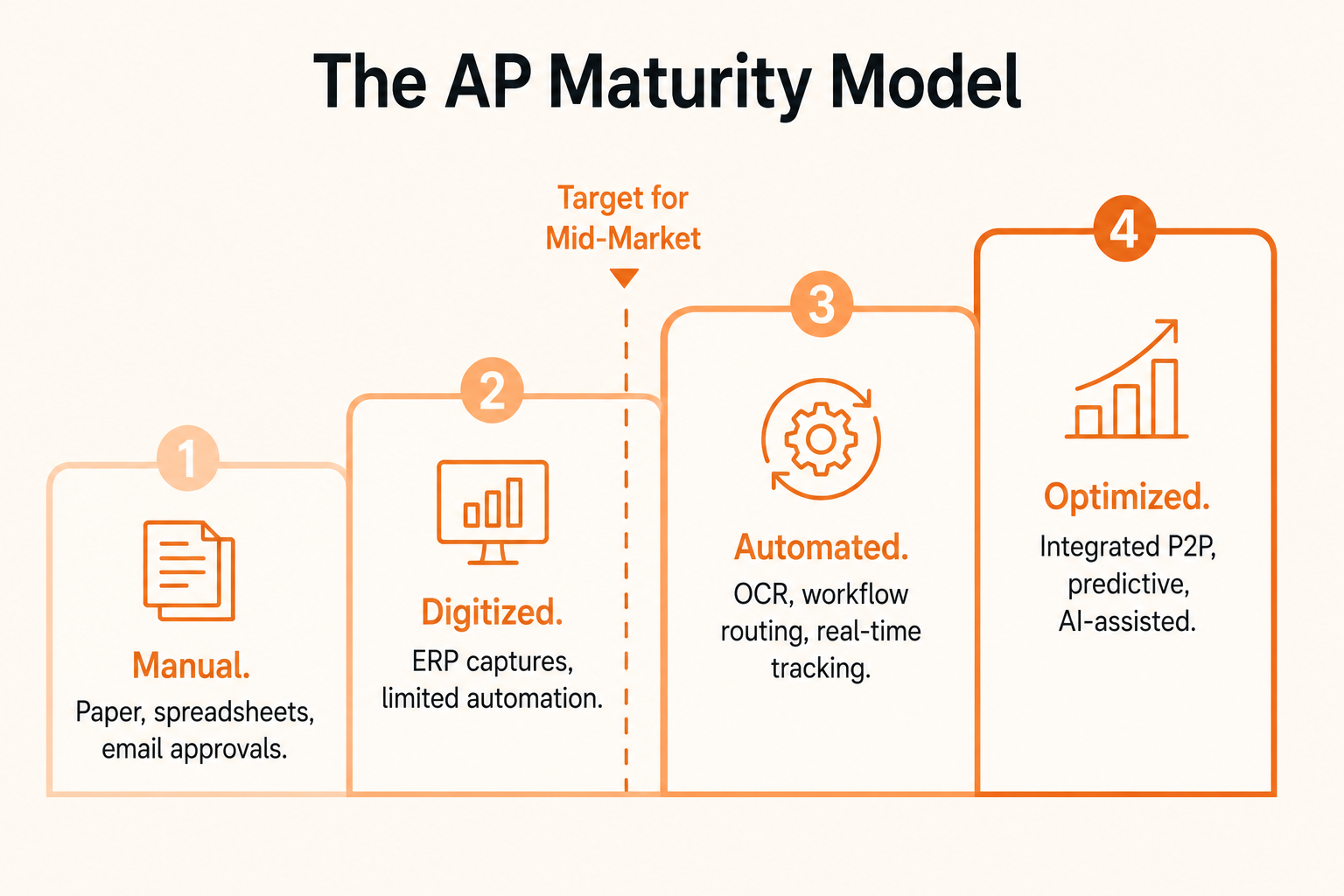
Most mid-market organizations evolve their AP function through four stages. Knowing which stage you are in helps you target the right improvements next.
Level | Description | Typical Characteristics |
|---|---|---|
1. Manual | Paper-heavy, spreadsheet-dependent | Paper invoices, manual data entry, email-based approvals, high error rate, no real-time visibility |
2. Digitized | Electronic invoices in an ERP, minimal automation | ERP captures invoices but most steps are still manual, basic approval routing, limited reporting |
3. Automated | OCR invoice capture and workflow automation | OCR extraction, automated three-way matching, automated approval routing by threshold, real-time tracking and dashboards |
4. Optimized | Integrated P2P with predictive analytics | Vendor self-service portals, predictive cash flow planning, dynamic discounting, AI-assisted exception handling, full P2P integration |
Mid-market companies should target Level 3 as the baseline for competitive operations. Level 4 is the destination for finance teams that have nailed the basics and are ready to use AP as a strategic lever rather than a process function.
Usually the gap between Level 2 and Level 3 is where most companies stall. The technology exists. The barrier is usually change management and the discipline of redesigning the process rather than digitizing the existing one.
For organizations considering an ERP implementation as part of the move from Level 2 to Level 3, see How to Implement NetSuite: Step-by-Step Guide for First-Time Buyers for the full implementation lifecycle and NetSuite Implementation Cost: How to Plan Your Year 1 Budget for the budget planning framework.
The Metrics That Matter
Tracking the right metrics keeps the AP function honest. Operational metrics measure efficiency. Financial metrics measure strategic outcomes. Both matter.
 Operational Metrics
Metric | What It Measures | Why It Matters |
|---|---|---|
Invoice cycle time | Days from invoice receipt to payment | Identifies process bottlenecks. Best-in-class: under 5 days for routine invoices. |
Cost per invoice | Fully-loaded cost (labor, system, overhead) per invoice processed | Tracks automation ROI over time. Manual: $10 to $15. Automated: $3 to $5. |
Invoices per AP full-time equivalent (FTE) | Invoice throughput per AP team member | Capacity benchmark. Strong mid-market teams: 5,000 to 10,000 per FTE annually. |
Exception rate | Percent of invoices requiring manual intervention | Lower is better. Above 20 percent suggests upstream data quality issues. |
First-pass match rate | Percent of invoices that match cleanly on first attempt | Higher is better. Above 80 percent indicates strong PO and receiving discipline. |
Financial Metrics
These are the metrics that connect AP to the broader working capital picture.
Payables Turnover Ratio. Measures how many times you pay your supplier base per year. A higher ratio than the industry average indicates faster payment, which supports liquidity. Calculation: total purchases divided by average accounts payable.
Days Payable Outstanding (DPO). The average number of days you take to pay suppliers. Higher DPO improves cash flow, but excessive DPO strains supplier relationships and may signal financial stress. Calculation: (Accounts Payable / Cost of Goods Sold) multiplied by 365.
Cash Conversion Cycle (CCC). The time it takes for cash invested in inventory to come back as cash from customers. The full equation: Days Inventory Outstanding (DIO) plus Days Sales Outstanding (DSO) minus DPO. A lower CCC is better, and extending DPO is one lever to shorten it.
Net Working Capital (NWC). Current Assets minus Current Liabilities. High and stable is healthy. A persistent decline can signal that payables are growing faster than the business can sustain. Persistently negative NWC is a serious liquidity warning.
Current Ratio and Quick Ratio. Both measure short-term liquidity. Current Ratio is Current Assets divided by Current Liabilities. Quick Ratio strips out inventory and measures the ability to pay current liabilities with cash and receivables alone. Rising AP levels reduce both ratios, all else equal. These are the metrics auditors and lenders watch.
The honest takeaway on metrics: optimizing any single metric in isolation is a trap. Maximizing DPO at the expense of supplier goodwill costs you in the next negotiation. Minimizing invoice cycle time without first improving exception rates just makes the process fast at being wrong. The strong AP function balances all of these together.
The Working Capital Balance: Why AP Decisions Cross Functions
Accounts payable is one of three components of working capital. The other two are accounts receivable and inventory. They interact constantly.
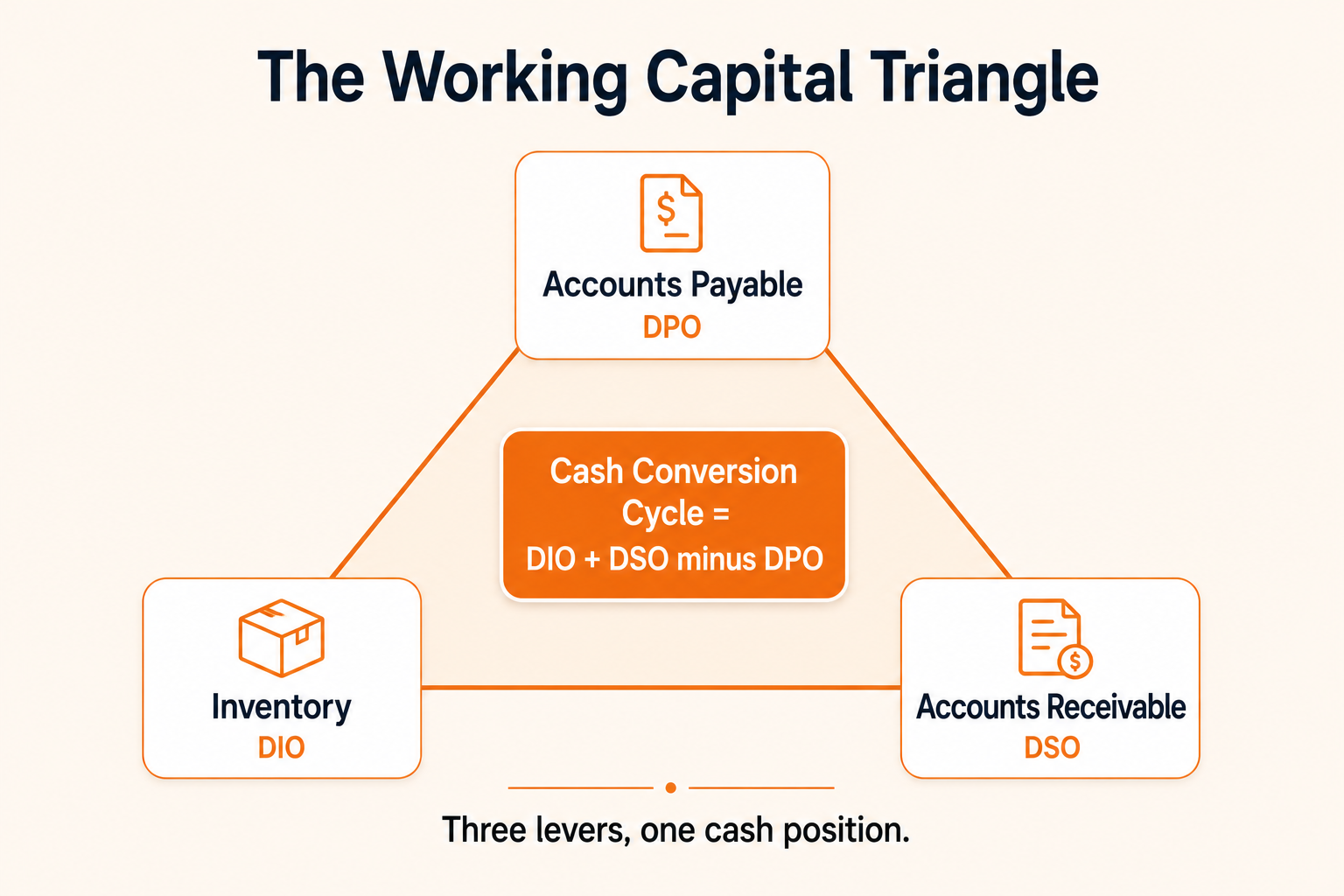
Stretching payables improves cash flow but only if it does not damage supplier relationships or trigger penalty terms. Tightening receivables improves cash flow but only if it does not reduce sales or create customer friction. Reducing inventory improves cash flow but only if it does not create stockouts.
The Cash Conversion Cycle ties them together. A company that holds inventory for 60 days, collects from customers in 45 days, and pays suppliers in 30 days has a CCC of 75 days. Every dollar of revenue is funded for 75 days. Extending DPO from 30 to 45 days, without changing the other two, cuts that to 60 days and frees significant working capital.
This is why AP cannot be optimized in isolation from procurement, receiving, and treasury. The decisions about credit terms, payment timing, and exception handling have downstream consequences for cash, working capital, and the operating cycle. The strong AP function is connected to the broader financial planning of the business, not run as a standalone operations function.
For multi-entity organizations where AP flows across subsidiaries, intercompany payables add another layer of complexity. See NetSuite OneWorld: Multi-Entity and Multi-Currency ERP Guide for how consolidation and intercompany elimination work in practice.
Putting It All Together
A high-performing AP function in a mid-market company has five characteristics:
Designed P2P, not just AP. The full process from requisition to payment is documented and owned end-to-end, not stitched together across departments.
System-enforced controls. Approval matrix, three-way matching with tolerances, vendor master discipline, and payment terms all live in the ERP rather than in someone's head.
Automation at the right points. Invoice capture, matching, and approval routing are automated. Exception handling remains human.
Metrics that connect to strategy. Operational metrics for efficiency, financial metrics for working capital, both reviewed monthly.
A working capital mindset. AP is treated as a lever for cash flow and supplier relationships, not as a cost center to minimize.
For mid-market companies, the move from Level 2 (digitized) to Level 3 (automated) on the maturity model is typically where the biggest gains live. The technology is available, the ROI is well-documented, and the change management is manageable with the right partner.
Talk to Softype about your AP process. We have designed and implemented end-to-end procure-to-pay workflows on NetSuite for mid-market and upper mid-market organizations across manufacturing, distribution, services, and multi-entity holding structures for 25 years.

Key Takeaways
Accounts payable management is the end-to-end process of handling a company's obligations to its suppliers, from invoice receipt to payment execution.
A complete Procure-to-Pay process moves through nine steps.
The single highest-impact lever in AP management is negotiating and using the maximum credit terms your suppliers will offer.
Modern Enterprise Resource Planning (ERP) systems include built-in tools to manage credit terms and supplier limits.
Manual invoice entry is the biggest bottleneck in AP at scale.
Three-way matching is the discipline of validating that the invoice, the Purchase Order, and the goods receipt agree before payment.
Frequently Asked Questions
Accounts payable management is the end-to-end process of handling a company's obligations to suppliers, from invoice receipt through validation, matching, approval, payment scheduling, and execution. It also includes vendor relationship management, credit terms negotiation, and performance monitoring through operational and financial metrics.
Three-way matching is the validation that a vendor invoice, the related Purchase Order, and the goods receipt all agree before payment is approved. The match checks item rate, quantity, and amount against a defined tolerance. Discrepancies above tolerance route the bill to manual review. Three-way matching is one of the most important fraud and overpayment controls in AP.
Operational metrics: invoice cycle time, cost per invoice, invoices per full-time equivalent (FTE), exception rate, first-pass match rate. Financial metrics: Days Payable Outstanding, Payables Turnover Ratio, Cash Conversion Cycle, Net Working Capital, Current Ratio, and Quick Ratio. Operational metrics measure process efficiency. Financial metrics measure strategic outcomes.
Best-in-class organizations process routine invoices in under 5 days. Manual operations often run 15 to 30 days. Automation typically brings cycle time down to hours for the common case, with exception handling extending some invoices to a few days.
AP automation typically reduces manual data entry by 60 to 80 percent, lowers cost per invoice by 50 percent or more, accelerates invoice processing from days to hours, and improves audit trail quality. For a mid-market company processing 10,000 invoices annually at $10 each, automation can save $50,000 or more per year in fully-loaded labor cost.
DPO is the average number of days your company takes to pay suppliers. The formula is (Accounts Payable / Cost of Goods Sold) multiplied by 365. Higher DPO improves cash flow and working capital, but excessive DPO can strain supplier relationships or signal financial stress. DPO is one of the three drivers of the Cash Conversion Cycle, alongside Days Inventory Outstanding and Days Sales Outstanding.
Fix the process first, then automate. Automating a broken process produces fast, consistent failure. The pattern we see in successful implementations: redesign the P2P flow end-to-end, clean the vendor master, establish three-way matching and approval rules, then layer in automation. Companies that try to skip the process work and go straight to automation usually end up redoing the implementation within two years.
AP management is the discipline of how the function operates: process design, controls, metrics, working capital strategy. AP automation is the technology layer that supports that discipline: Optical Character Recognition (OCR) invoice capture, automated matching, workflow routing, payment runs. Good AP management can exist without automation, but automation without good management amplifies whatever you already have, including the problems.
Further Reading
For the vendor-published detail behind the capabilities described above, Oracle maintains official documentation:
Related Posts


Helping businesses thrive with integrated ERP solutions.
NetSuite
Service
Company
Contact Us
Copyright © 2026


